TL;DR
- Peptides can influence appetite, recovery, skin quality, or selected signaling pathways, but they do not replace resistance training.
- GLP-1 drugs can drive weight loss, but some of that loss can come from muscle if lifting and protein are not part of the plan.
- GHK-Cu and many glow-blend style peptides have narrower roles than the marketing suggests.
- Muscle is the tissue that supports metabolism, strength, insulin sensitivity, and long-term physical capability.
- Peptides can support a process, but training determines the adaptation.
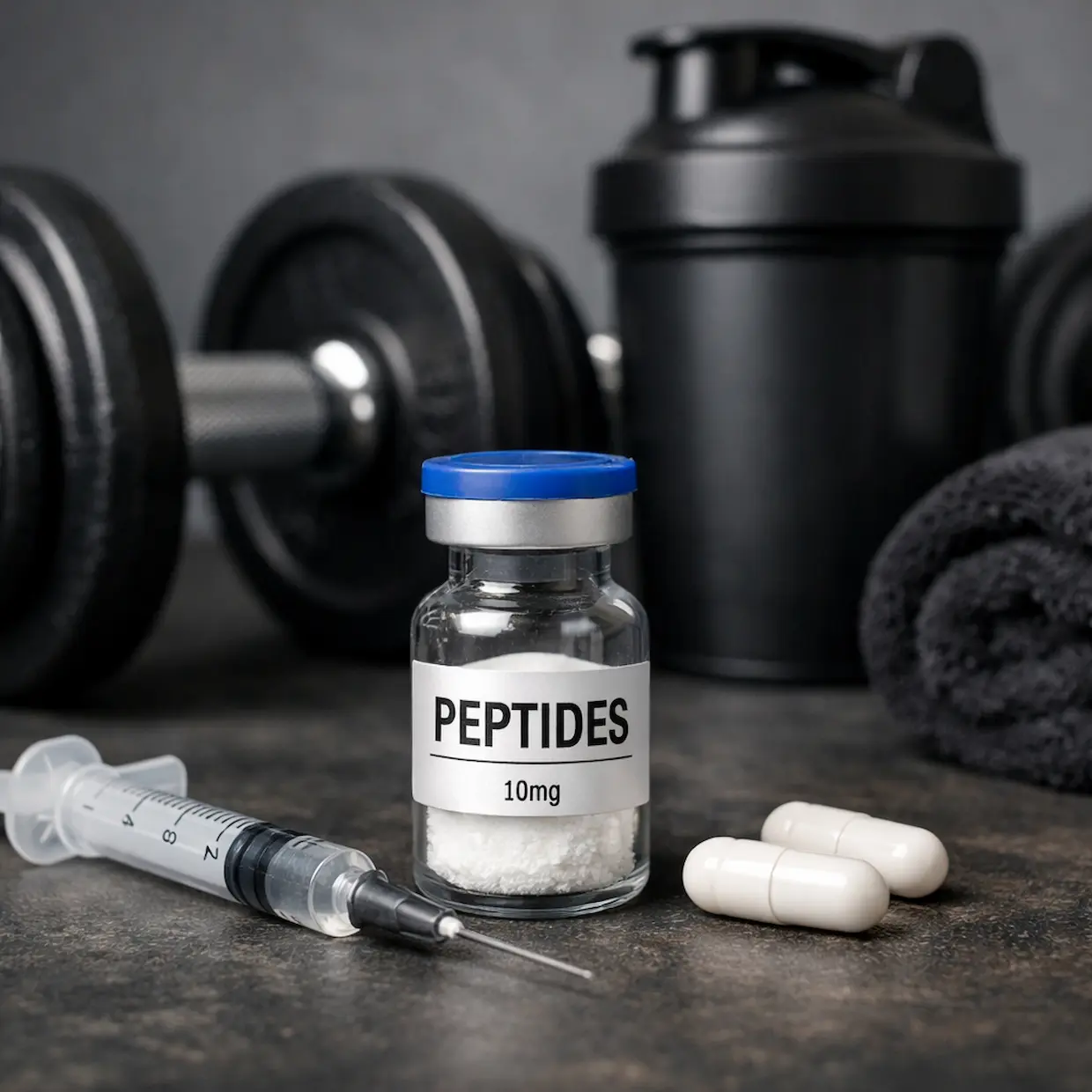
Peptides are everywhere right now. GLP-1 drugs are driving rapid weight loss, GHK-Cu is being positioned as a skin and anti-aging solution, and glow-blend style compounds are marketed as recovery and longevity shortcuts.
The pitch is simple: take the right compound and your body improves.
That idea is appealing, but it leaves out the mechanism that actually determines long-term body composition.
Peptides can change signals in the body. They can influence appetite, inflammation, skin remodeling, recovery perception, or selected metabolic pathways. What they do not do is force the body to adapt in the way resistance training does.
They do not build meaningful muscle on their own. They do not improve strength by themselves. They do not increase physical capacity just because they are present.
They change the environment. They do not define the outcome.
As Felix Tsatryan emphasizes in private performance coaching, the foundation still has to be training, muscle, and physical adaptation. Compounds may influence the process, but the body is ultimately shaped by the demands placed on it.
How Peptides Work on Their Own
The word peptide covers a wide range of compounds, so not every peptide works the same way. Some influence appetite. Some are marketed around tissue repair. Some are discussed in skin, collagen, or inflammation contexts.
That variety is exactly why the marketing can become confusing. A compound may influence one pathway and still have very little impact on strength, muscle, or body composition.
GLP-1 receptor agonists are the clearest example. They reduce appetite, slow gastric emptying, and make it easier to eat less. That can create a calorie deficit, and body weight drops.
But lower body weight is not automatically better body composition.
When energy intake falls and the body does not receive a strong reason to preserve muscle, it becomes efficient. It reduces what it considers expensive tissue. Muscle falls into that category.
Without a demand for strength and output, some lean mass can be lost alongside fat. That is why someone can become lighter while also becoming flatter, weaker, and less metabolically capable.
Track what is actually changing
Peptides may shift appetite or recovery, but body composition tells you what is happening underneath the scale. Use the Body Composition Estimator to compare estimated fat mass, lean mass, body water, and metabolic context.
The Missing Link Is Muscle
Muscle is not just something that changes how the body looks. It changes how the body functions.
Muscle tissue helps regulate glucose disposal, insulin sensitivity, movement quality, metabolic reserve, strength, and physical resilience. It gives the body a larger functional base to operate from.
That matters because fat loss, anti-aging, recovery, and performance are not isolated outcomes. They are connected to the amount of capable tissue the body has and how well that tissue is trained.
Peptides may influence signals around the process, but muscle gives the body the structure to make that process meaningful.
A person who loses weight without preserving muscle may look smaller but less capable. A person who preserves or builds muscle while reducing fat usually changes in a more useful direction.
That distinction is explained more deeply in GLP-1 Weight Loss Drugs and Muscle Loss: Why Lifting Weights Matters.
Why Resistance Training Changes the Outcome
Resistance training creates mechanical tension. That tension tells the body that muscle is needed.
This is a different kind of signal than anything a peptide can provide. It is direct, physical, and adaptive. The body experiences load, force production, joint stabilization, coordination demand, and recovery demand.
When that demand is repeated and progressed over time, the body adapts by maintaining or increasing the tissue and skill required to meet it.
The rate of growth will still slow as training experience accumulates. That does not mean a peptide is needed to restart progress. It means the next improvement has to come from identifying what is actually limiting the muscle growth curve, whether that is training demand, protein, total food intake, or recovery.
That is why lifting changes the body in a way that passive interventions do not. A compound may make the process easier or influence selected pathways, but training gives the body the reason to preserve and improve.
Physiology Lens
Signals are not the same as adaptation.
A peptide can influence a signal. Training creates a demand. The body adapts when demand is strong enough, repeated enough, and supported by recovery and nutrition.
Demand + recovery + nutrition = adaptation
Why GHK-Cu and Glow Blends Are Often Overstated
GHK-Cu is commonly discussed around skin quality, collagen signaling, and localized tissue support. That can make it relevant in certain appearance or recovery conversations.
But that is a narrow role. It does not build meaningful muscle, improve strength, or create body recomposition on its own.
Many glow-blend style products go even further. They are often positioned as broad anti-aging or recovery shortcuts even when the claims are much larger than the practical effect.
Even if a compound influences a pathway, the body still needs a reason to become stronger. It still needs protein. It still needs sleep. It still needs progressive training. It still needs enough total energy to recover from the demand placed on it.
That is where the difference between marketing and physiology becomes obvious.
Peptides Do Not Replace Protein
Protein provides amino acids. Amino acids are the raw materials the body uses for repair, muscle retention, and adaptation.
If a person is eating too little protein, no peptide changes the basic problem: the body lacks enough building material.
This becomes especially important during fat loss. When calories are lower, the body is under more pressure to lose lean mass. Protein helps support the tissue that training tells the body to keep.
Set the protein target first
If the goal is fat loss, muscle retention, or recomposition, protein intake should be structured before chasing advanced compounds. Use the Protein Calculator to estimate a practical daily target.
Why Anti-Aging Depends on Physical Capacity
Anti-aging is often marketed as appearance: smoother skin, faster recovery, better sleep, or less inflammation.
Those things can matter, but they are not the whole picture.
Long-term aging is also about whether the body can produce force, climb stairs, stabilize joints, regulate blood sugar, recover from stress, and stay physically capable.
That is why muscle matters so much. Muscle is functional reserve.
A person can look better from the outside while quietly losing strength and metabolic capacity. That is not a better long-term outcome.
The better target is to improve appearance while preserving or increasing the physical systems that make the body resilient.
Where Peptides Can Fit
This does not mean peptides are useless. It means they should not be treated as the foundation.
A compound may support appetite control, adherence, selected recovery pathways, or narrow appearance goals. But the larger system still depends on training, nutrition, hydration, sleep, and measurement.
Peptides can assist the process. They cannot replace it.
01
Peptides
May influence appetite, skin, recovery perception, or selected biological signals.
02
Training
Creates the mechanical demand that tells the body to preserve or build muscle.
03
Muscle
Supports strength, metabolism, insulin sensitivity, resilience, and long-term function.
What Matters Most
Peptides are tools. Without resistance training, they are physiologically incomplete.
They may make parts of the process easier. They may improve adherence, influence specific pathways, or support narrow outcomes. But they do not decide what kind of body is left behind.
That is determined by adaptation.
Without lifting, the body can become smaller but weaker. Lighter, but less capable. With lifting, the body has to preserve muscle, improve efficiency, and build a stronger foundation for long-term results.
Peptides can assist the process. They cannot replace it.
Keep These Priorities Straight
- Peptides can alter signals in the body, but they do not create lasting adaptation on their own.
- GLP-1 drugs can reduce appetite and drive weight loss, but without lifting, some of that loss can come from muscle.
- GHK-Cu and glow-blend style peptides may support narrow goals, but they do not meaningfully replace training.
- Resistance training tells the body to preserve muscle, improve metabolic efficiency, and become more capable over time.
- Peptides can support a well-built system. They cannot replace the role of muscle in long-term performance and body composition.
A compound can change a signaling pathway without proving that it builds useful muscle, speeds recovery, or improves longevity. A small randomized CJC-1295 trial showed sustained increases in GH and IGF-1, but it did not establish those larger outcomes.[1]
GHK-Cu has plausible tissue-remodeling effects, especially in laboratory, animal, and topical research, while large human trials remain limited. The FDA also identifies significant evidence and safety gaps for several compounded peptides discussed online, including BPC-157, CJC-1295, injectable GHK-Cu, and ipamorelin.[2][3]
Research and References
The evidence is strongest for biological signaling and weakest for the broad transformation claims often made in marketing.
- Teichman et al. “Prolonged stimulation of growth hormone and insulin-like growth factor I secretion by CJC-1295.” This randomized trial measured hormone responses in healthy adults; it was not a muscle-building or longevity trial. View on PubMed.
- Local and Systemic Peptide Therapies for Soft Tissue Regeneration. This review describes promising GHK-Cu mechanisms while emphasizing how much of the evidence comes from preclinical or limited human research. Read the review.
- U.S. Food and Drug Administration. “Certain Bulk Drug Substances for Use in Compounding that May Present Significant Safety Risks.” The FDA summarizes safety concerns and areas where human information remains limited. Read the FDA assessment.
FAQ
Can peptides build muscle without training?
Peptides do not replace the mechanical tension and progressive overload required to build meaningful muscle. Training is still the primary adaptation signal.
Are GLP-1 drugs considered peptides?
Many GLP-1 receptor agonists are peptide-based medications or peptide-like compounds that influence appetite, blood sugar regulation, and gastric emptying.
Does GHK-Cu improve body composition?
GHK-Cu is usually discussed for skin, collagen, and tissue-support pathways. It should not be treated as a meaningful replacement for strength training or nutrition.
Why does muscle matter for anti-aging?
Muscle supports strength, insulin sensitivity, movement capacity, metabolic reserve, and resilience. Those qualities affect functional aging more than appearance alone.
Can peptides help recovery?
Some compounds are marketed for recovery, but recovery still depends heavily on training dose, sleep, protein intake, hydration, and total stress management.
Should someone lift weights while using peptides?
If the goal is body composition, strength, or long-term performance, resistance training should remain the foundation regardless of peptide use.
Do peptides replace protein intake?
No. Protein provides amino acids needed for muscle repair and retention. Peptides do not replace adequate nutrition.
What is the biggest mistake people make with peptides?
The biggest mistake is treating peptides as the main driver while neglecting the basics: resistance training, protein intake, sleep, hydration, and consistent measurement.